Unveiling the Masterpieces: Your Art History Timeline
art history timeline

Unveiling the Masterpieces: Your Art History Timeline

Journey through millennia of human creativity, understanding the forces that shaped our visual world.

Begin Your Art Journey

Key Takeaways

  • ✓ Art history spans over 40,000 years, from cave paintings to digital installations.
  • ✓ Major art movements often reflect societal, political, and technological shifts.
  • ✓ Understanding art history provides context for contemporary artistic expressions.
  • ✓ Regional variations significantly influence artistic styles and interpretations.

How It Works

1
Explore Epochs

Delve into distinct periods like Renaissance, Baroque, or Modernism. Each era has unique characteristics and philosophical underpinnings.

2
Identify Key Artists & Works

Learn about the influential figures and their seminal creations. Understand how their innovations pushed boundaries and inspired future generations.

3
Grasp Context & Influence

Connect art to its historical, cultural, and scientific environment. Discover how events shaped artistic expression and vice-versa.

4
Trace Evolution & Connections

See how styles and ideas evolve, with later movements often reacting to or building upon earlier ones. Recognize the threads that weave through art history.

The Dawn of Creativity: Prehistoric & Ancient Civilizations
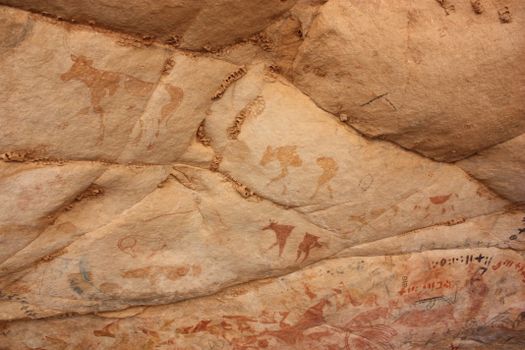
Discover ancient rock art depicting prehistoric life on Algerian cave walls. Photo: Baidou Ahmed / Pexels
The story of art begins long before written records, etched into cave walls and sculpted from primitive materials. The Upper Paleolithic period, roughly 40,000 to 10,000 BCE, marks the earliest known artistic endeavors. The Chauvet Cave in France, for instance, boasts stunning animal depictions that demonstrate sophisticated observational skills and an understanding of perspective, long before such concepts were formalized. These early works weren't merely decorative; they likely served ritualistic, spiritual, or educational purposes, perhaps aiding in hunting magic or communicating tribal knowledge. They are a testament to humanity's innate drive to create and interpret its world. As civilizations began to coalesce, art evolved in complexity and purpose. Ancient Mesopotamian art, spanning from Sumerian to Assyrian and Babylonian empires (c. 3500-539 BCE), was largely functional, serving religious and political propaganda. Ziggurats, cylinder seals, and relief sculptures celebrated deities and glorified rulers, often depicting epic narratives and military victories. The famous Standard of Ur, a Sumerian artifact, offers a vivid glimpse into early societal structures and warfare. Ancient Egyptian art, enduring for over 3,000 years (c. 3100-30 BCE), is characterized by its remarkable consistency and adherence to strict conventions. Driven by a profound belief in the afterlife, Egyptian art was primarily funerary and religious. Tombs, temples, and colossal statues were designed to ensure the eternal well-being of the deceased and to honor the gods. Hieroglyphics, often integrated into murals and papyri, blended text and image seamlessly. The Great Pyramids of Giza, the intricate sarcophagi, and the vibrant wall paintings of the Valley of the Kings exemplify a civilization obsessed with order, permanence, and the divine. Their artistic canon, with its frontal poses and composite views, remained largely unchanged for millennia, reflecting a desire for stability and timelessness. This foundational period laid the groundwork for many artistic principles that would be re-explored and reinvented in later eras, demonstrating the enduring power of visual communication across vast stretches of time. Understanding these early forms is crucial for appreciating the entire artistic journey.

Classical Ideals & Medieval Devotion: Greece, Rome & the Middle Ages
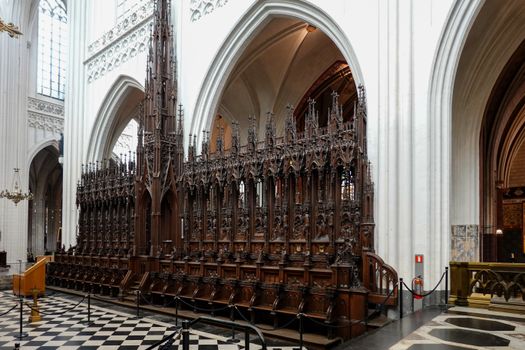
Intricately carved wooden choir stalls inside a stunning Gothic cathedral. Photo: Magda Ehlers / Pexels
The classical world of Ancient Greece (c. 800-600 BCE to 31 BCE) ushered in an era focused on humanism, rationality, and the pursuit of ideal beauty. Greek art, particularly sculpture and architecture, sought to capture perfect proportions, harmony, and balance. The Doric, Ionic, and Corinthian orders defined architectural elegance, while sculptures like the Discobolus or the Venus de Milo showcased a mastery of human anatomy and a fascination with the idealized form. Greek pottery, adorned with black-figure and red-figure techniques, depicted mythological scenes and daily life, offering invaluable insights into their culture. Philosophers like Plato and Aristotle profoundly influenced artistic theory, emphasizing mimesis (imitation) and the pursuit of abstract ideals. Roman art (c. 509 BCE to 476 CE), while heavily influenced by Greek precedents, developed its own distinct character, often more pragmatic, realistic, and monumental. Roman architecture excelled in engineering, utilizing concrete to construct impressive structures like the Colosseum, Pantheon, and aqueducts. Portraiture became highly individualized, reflecting the Roman emphasis on civic duty and ancestral lineage. Roman mosaics and frescoes adorned villas, depicting scenes from mythology, nature, and everyday activities, showcasing a vibrant domestic artistic tradition. Following the collapse of the Western Roman Empire, the Middle Ages (c. 500-1500 CE) saw art become predominantly spiritual and didactic, serving the Christian Church. Early Christian art adapted Roman forms for new religious content, while Byzantine art (c. 330-1453 CE), centered in Constantinople, developed a distinctive style characterized by glittering mosaics, flattened figures, and a focus on abstract, spiritual symbolism. Icons became central to worship, their stylized forms intended to convey divine presence rather than earthly realism. Romanesque art (c. 1000-1200 CE) emerged with the building of massive stone churches, featuring heavy walls, rounded arches, and elaborate sculptural programs on portals and capitals that told biblical stories to a largely illiterate populace. Gothic art (c. 1150-1500 CE), originating in France, revolutionized architecture with its soaring cathedrals, pointed arches, ribbed vaults, and expansive stained-glass windows that flooded interiors with divine light. Figures became more naturalistic, expressing emotion and narrative clarity, reflecting a shift towards a more human-centered spirituality even within the confines of religious doctrine. These periods demonstrate a profound interplay between faith, power, and artistic expression, shaping the visual culture of Western civilization for a millennium.

Rebirth & Enlightenment: Renaissance to Neoclassicism
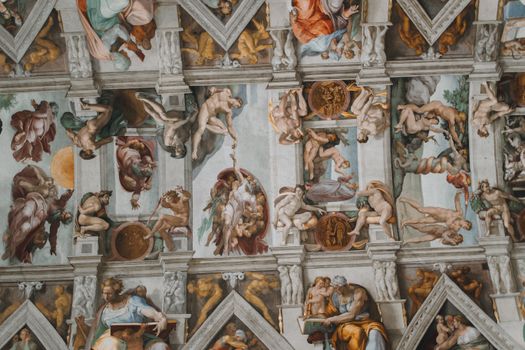
Intricate frescoes on the Sistine Chapel ceiling by Michelangelo, Vatican City. Photo: Alina Rossoshanska / Pexels
The Renaissance (c. 1300-1600 CE) marked a profound 'rebirth' of classical ideals, fueled by a renewed interest in humanism, scientific inquiry, and individual achievement. Originating in Italy, this period saw revolutionary advancements in painting, sculpture, and architecture. Artists like Giotto laid the groundwork for naturalism, while Masaccio introduced linear perspective, creating unprecedented depth and realism. The High Renaissance (c. 1490-1527) produced titans such as Leonardo da Vinci, whose 'Mona Lisa' and 'Last Supper' exemplify psychological depth and technical mastery; Michelangelo, with his monumental sculptures like 'David' and the Sistine Chapel ceiling; and Raphael, known for his harmonious compositions and serene Madonnas. Northern Renaissance artists like Jan van Eyck and Albrecht Dürer focused on meticulous detail, rich symbolism, and oil painting techniques, bringing a different flavor of realism to their work. The Renaissance emphasized the dignity of man and celebrated human potential, shifting art's focus from purely spiritual to a broader range of human experience. The subsequent Baroque era (c. 1600-1750 CE) was a period of dramatic grandeur, emotional intensity, and dynamic movement. Fueled by the Counter-Reformation, Baroque art aimed to evoke strong emotions and inspire awe. Artists like Caravaggio employed dramatic chiaroscuro (light and shadow) to create powerful, often gritty, realism, while Gian Lorenzo Bernini's sculptures and architectural designs exploded with theatricality and elaborate ornamentation. Peter Paul Rubens's canvases teemed with vibrant color and energetic forms, and Rembrandt van Rijn explored the human condition with unparalleled psychological insight through his portraits and biblical scenes. In architecture, Baroque churches and palaces were designed to overwhelm with their opulence and scale, often integrating painting, sculpture, and stucco work into a unified, immersive experience. Following the Baroque, the Rococo style (c. 1720-1780 CE) emerged as a lighter, more playful, and decorative aesthetic, often associated with the French aristocracy. Characterized by delicate pastels, curvilinear forms, and themes of love and leisure, artists like Antoine Watteau and Jean-Honoré Fragonard created intimate, charming scenes. However, a reaction against Rococo's perceived frivolity led to Neoclassicism (c. 1760-1850 CE). Inspired by the archaeological discoveries of Pompeii and Herculaneum and the ideals of the Enlightenment, Neoclassical art championed order, logic, and moral rectitude, drawing heavily from classical Greek and Roman models. Jacques-Louis David's 'Oath of the Horatii' is an iconic example, emphasizing civic virtue and stoicism through its crisp lines and heroic subject matter. This period reflects a return to clarity and reason, profoundly influencing not only art but also political thought and revolutionary movements, setting the stage for the tumultuous changes of the 19th century. Explore these transformative eras further in our guide to artistic styles.

The Modern Explosion: From Impressionism to Contemporary Art

A woman in a gallery intently observes abstract paintings, highlighting her engagement with modern art. Photo: Greta Hoffman / Pexels
The 19th century witnessed a rapid succession of art movements, each challenging previous conventions and pushing the boundaries of artistic expression. Romanticism (c. 1800-1850 CE) reacted against Neoclassical rationality, embracing emotion, individualism, and the sublime in nature. Artists like Eugène Delacroix and J.M.W. Turner explored dramatic narratives, exoticism, and the power of the natural world. Realism (c. 1840-1880 CE), spearheaded by Gustave Courbet, rejected idealized subjects in favor of depicting everyday life and social commentary, often focusing on the working class. This paved the way for Impressionism (c. 1860-1890 CE), a revolutionary movement that sought to capture fleeting moments and the effects of light and color. Claude Monet, Pierre-Auguste Renoir, and Edgar Degas broke from traditional academic painting, using visible brushstrokes and an outdoor (plein air) approach. Post-Impressionism (c. 1880-1900 CE), with artists like Vincent van Gogh, Paul Cézanne, and Georges Seurat, further explored personal expression, structural form, and scientific color theory, laying critical groundwork for 20th-century art. The 20th century unleashed an unprecedented explosion of avant-garde movements. Fauvism (Henri Matisse), Cubism (Pablo Picasso, Georges Braque), and German Expressionism (Ernst Ludwig Kirchner) shattered traditional representation, exploring color as an independent element, fractured perspectives, and raw emotional intensity. Surrealism (Salvador Dalí, René Magritte) delved into the subconscious and dream imagery, while Abstract Expressionism (Jackson Pollock, Mark Rothko) emphasized spontaneous, gestural, or color-field painting as a means of profound emotional release after World War II. Pop Art (Andy Warhol, Roy Lichtenstein) reacted against Abstract Expressionism's seriousness, embracing popular culture, consumerism, and mass media imagery. Minimalism, Conceptual Art, and Performance Art emerged in the latter half of the century, questioning the very definition of art itself, prioritizing ideas and experiences over traditional objects. Contemporary art, from the late 20th century to the present, is incredibly diverse and defies easy categorization. It encompasses a vast array of media, including digital art, installation art, video art, and new media. Artists today often engage with global issues, identity, technology, and social commentary, reflecting a complex and interconnected world. There is a strong emphasis on conceptual depth, interdisciplinary approaches, and audience engagement. This period is characterized by a pluralism of styles and a constant re-evaluation of art's role and purpose, continuing the dynamic evolution seen throughout the entire art history timeline.

Comparison

FeatureRenaissanceBaroqueImpressionismContemporary
Dominant ThemeHumanism, OrderDrama, EmotionLight, MomentDiversity, Concept
Key TechniqueLinear PerspectiveChiaroscuro, MovementVisible BrushstrokesMixed Media, Digital
Ideal Beauty
Emotional ImpactSubtleHighAtmosphericVaried, Intellectual

What Readers Say

"This art history timeline is incredibly well-structured and easy to follow. I finally understand how different periods connect and influence each other. It's a fantastic resource for students and art lovers alike."

Sarah L. · Austin, TX

"As an aspiring artist, grasping the flow of art history is crucial. This article breaks down complex movements into digestible parts, making it accessible without sacrificing depth. Highly recommend for anyone curious about art's evolution."

Mark D. · New York, NY

"I used to feel overwhelmed by the sheer volume of art periods, but this art history timeline provided a clear roadmap. I now confidently discuss key artists and movements, which has significantly enhanced my gallery visits."

Emily C. · Los Angeles, CA

"While incredibly comprehensive, I'd love to see even more examples of non-Western art integrated into the main timeline. Nevertheless, it's an exceptional overview of Western art history and a valuable educational tool."

David R. · Chicago, IL

"I'm a history buff, not primarily an art person, but this timeline brilliantly connects art to broader societal shifts. It made me appreciate art as a historical document, offering a unique lens into past cultures."

Jessica M. · Miami, FL

Frequently Asked Questions

What is the earliest known art on the art history timeline?

The earliest known art dates back to the Upper Paleolithic period, roughly 40,000 years ago, with cave paintings like those found in Chauvet Cave, France. These ancient expressions demonstrate early human cognitive abilities and their connection to their environment, often depicting animals and symbolic figures.

Is an understanding of art history essential for contemporary artists?

While not strictly 'essential' for all contemporary artists, a strong understanding of art history provides invaluable context, inspiration, and a foundation for innovation. Many contemporary movements are direct reactions to, or re-interpretations of, past styles and ideas, making historical knowledge a powerful tool for informed artistic practice.

How can I best navigate the vastness of the art history timeline?

Start with broad overviews of major epochs, then delve deeper into specific movements or artists that pique your interest. Utilize online resources, museum visits, and books. Focusing on connections between periods and understanding the societal context behind the art can make the journey more engaging and less overwhelming.

Does studying the art history timeline offer practical benefits?

Absolutely. Beyond cultural enrichment, studying art history enhances critical thinking, visual literacy, and analytical skills. It provides insight into human psychology, history, and cultural evolution, fostering a more nuanced understanding of the world and developing skills applicable across many professions.

How does technology influence the modern art history timeline?

Technology has profoundly influenced modern art, both as a medium and a subject. Digital art, video art, and interactive installations are new forms. Additionally, technology aids in art preservation, analysis, and global dissemination, making art history more accessible and dynamic than ever before.

Who should explore the art history timeline?

Anyone with a curiosity about human creativity, culture, and history will benefit from exploring the art history timeline. It's ideal for students, aspiring artists, art enthusiasts, historians, and anyone seeking a deeper appreciation for the visual world around them. It offers a rich tapestry of human experience through the ages.

Are there biases in the traditional art history timeline?

Yes, traditional art history timelines have historically focused heavily on Western art, often overlooking or minimizing contributions from non-Western cultures, women artists, and artists of color. Contemporary art history actively seeks to redress these biases, promoting a more inclusive and global perspective on artistic development.

What's the future trend for the art history timeline?

The future of the art history timeline is likely to be increasingly global, interdisciplinary, and digitally integrated. Expect greater emphasis on diverse cultural narratives, the impact of new technologies like AI and VR on art creation and viewing, and a continuous re-evaluation of what constitutes 'art' in an ever-changing world.

Embark on your journey through the art history timeline today. Discover the masterpieces, movements, and minds that have shaped human creativity, enriching your understanding of our shared cultural heritage. Start exploring the incredible legacy of art now.

Topics: art history timelineart movementshistorical art periodsart evolutionfamous artists
Leo List
Brampton weed
Adultwork EstrelaBet Vai de Bet R7 Bet Betão Galera Bet Rainbet Bet9ja Shop SportyBet BetKing Sisal Loto Foot Hollywoodbets YesPlay Odibets RushBet Jugabet BetWarrior BetCity MSport betPawa Fortebet