✓ Sculpture is one of the oldest art forms, dating back to prehistory.
✓ Many famous sculptures hold deep cultural, religious, and political significance.
✓ The materials used in sculpture range from stone and metal to wood and even light.
✓ Understanding the artist's context is crucial to appreciating their sculptural work.
How It Works
1
Select Your Era
Choose a historical period, from ancient civilizations to the modern age, to focus your exploration. Each era presents distinct artistic styles and philosophical underpinnings.
2
Discover Key Sculptors
Learn about the visionary artists who pushed the boundaries of their craft. Understand their lives, inspirations, and the challenges they faced.
3
Analyze Masterpieces
Delve into specific famous sculptures, examining their composition, symbolism, and the techniques employed. Consider their impact on subsequent art and culture.
4
Connect with Art History
See how these individual works and artists fit into the broader tapestry of art history. Appreciate the evolution of sculptural expression across centuries.
The Dawn of Form: Ancient Wonders and Their Creators
Photo: dilara irem / Pexels
The story of sculpture begins not in grand museums, but in the earliest stirrings of human creativity. Long before recorded history, our ancestors were shaping materials, driven by a primal urge to represent their world, their beliefs, and themselves. The Venus of Willendorf, a small limestone figurine dating back approximately 25,000-30,000 years, stands as one of the most ancient and enigmatic famous sculptures. While the artist remains anonymous, this piece offers invaluable insight into prehistoric societies' reverence for fertility and the feminine form. Its exaggerated features suggest a symbolic rather than realistic depiction, perhaps serving as a talisman or an object of ritual.
Moving into the Bronze Age, the civilizations of Mesopotamia and Egypt pioneered monumental sculpture. The Great Sphinx of Giza, a colossal limestone statue with the body of a lion and the head of a human, is arguably one of the most recognizable sculptures globally. Carved around 2500 BC, its creation is attributed to the pharaoh Khafre, whose face it is believed to represent. This iconic work embodies the power and divine authority of the pharaohs, guarding their eternal resting places. The sheer scale and precision of its carving, executed with rudimentary tools, speak volumes about the organizational capabilities and artistic prowess of ancient Egyptians. Similarly, Assyrian winged genies and Egyptian pharaonic statues, often carved from durable materials like diorite or granite, served to immortalize rulers and deities, ensuring their presence for eternity. These early works were not merely decorative; they were imbued with profound spiritual and political significance, shaping the visual culture of their respective empires.
Classical antiquity, particularly ancient Greece, elevated sculpture to an art form focused on idealism, human anatomy, and narrative. Greek sculptors, though many are now known only through Roman copies, achieved an unparalleled mastery of the human form. Praxiteles, one of the most celebrated Greek sculptors of the 4th century BC, is renowned for introducing a more sensual and graceful approach to his figures. His 'Aphrodite of Knidos' was revolutionary for being one of the first life-sized nude female statues, setting a new standard for portraying divine beauty. Though the original is lost, its numerous copies testify to its immense influence. Another titan of Greek sculpture was Phidias, responsible for the monumental chryselephantine (gold and ivory) statue of Zeus at Olympia, one of the Seven Wonders of the Ancient World, and the sculptural decorations of the Parthenon. His work exemplified the High Classical style, characterized by harmony, balance, and idealized realism. These sculptures were not just aesthetic objects; they were central to religious worship, public life, and the very identity of the Greek city-states, reflecting their philosophical ideals of order and human potential. The evolution from anonymous prehistoric carvings to individually recognized masters like Praxiteles highlights a significant shift in the perception of the artist and the value placed on their unique contribution to art. The legacy of these ancient famous sculptures and their artists laid the foundational grammar for centuries of Western art, demonstrating the enduring power of sculpted form to convey meaning and inspire awe.
Renaissance Revival: Humanism in Stone and Bronze
The Renaissance marked a profound resurgence of interest in classical ideals, coupled with a revolutionary emphasis on humanism and individual achievement. This period, spanning roughly from the 14th to the 17th century, saw an explosion of artistic innovation, with sculpture playing a central role in expressing new philosophical and theological insights. Italian artists, in particular, led this charge, drawing inspiration from the anatomical precision and narrative power of ancient Greek and Roman works, but infusing them with a new psychological depth and emotional intensity.
Donatello (c. 1386–1466) stands as a pivotal figure in early Renaissance sculpture. His bronze 'David' (c. 1440s) is groundbreaking for several reasons. It was the first freestanding nude male sculpture since antiquity, boldly reintroducing the classical form. More importantly, it portrays David not as a triumphant warrior, but as a youthful, contemplative figure, embodying a nascent humanism that celebrated individual spirit and vulnerability. Donatello’s mastery of bronze casting and his ability to convey character marked a significant departure from the more rigid, stylized forms of the medieval period. His work paved the way for subsequent generations of sculptors, demonstrating the expressive potential of the medium.
Michelangelo Buonarroti (1475–1564) is arguably the most famous sculptor of all time, a true titan of the High Renaissance. His name is synonymous with monumental marble masterpieces that seem to breathe with life. His 'David' (1501–1504), carved from a single block of marble, is a testament to his unparalleled skill and profound understanding of human anatomy. Unlike Donatello's introspective youth, Michelangelo's David is a powerful, tense figure, poised for action, representing the ideal of human strength and moral courage. The 'Pietà' (1498–1499), depicting Mary cradling the dead Christ, is another of his early masterpieces, celebrated for its exquisite tenderness, anatomical accuracy, and emotional resonance. Michelangelo's belief that a sculpture already existed within the marble, waiting to be released, speaks to his reverence for the material and his profound artistic vision. His work, alongside his contemporary Leonardo da Vinci, defined the artistic zenith of the period.
Another essential figure is Gian Lorenzo Bernini (1598–1680), who dominated the Baroque period in Rome. Bernini’s sculptures are characterized by their dramatic theatricality, dynamic movement, and intense emotional expression, often integrating architecture and light to create immersive experiences. His 'Ecstasy of Saint Teresa' (1647–1652) is a prime example, depicting the saint in a moment of spiritual rapture, enveloped by swirling drapery and divine light. The 'Apollo and Daphne' (1622–1625) captures a mythological narrative at its climactic moment, showcasing Daphne’s transformation into a laurel tree with breathtaking realism and movement. Bernini's ability to manipulate marble to convey the softness of flesh, the texture of fabric, and the fleeting nature of emotion is truly astonishing. These famous sculptures and their artists from the Renaissance and Baroque periods didn't just revive classical forms; they infused them with a new spirit, celebrating the human condition in all its complexity and grandeur, forever changing the trajectory of Western art.
Modern Marvels: Innovation and Abstraction in Sculpture
The 19th and 20th centuries witnessed a radical transformation in sculpture, as artists broke away from traditional academic norms to explore new materials, forms, and conceptual approaches. This period of intense experimentation gave rise to a diverse array of styles, from Rodin's emotional realism to Brancusi's elegant abstraction and beyond, forever expanding the definition of what sculpture could be. The modern era challenged viewers to reconsider their expectations, moving beyond mere representation to engage with ideas, emotions, and the inherent properties of materials themselves.
Auguste Rodin (1840–1917) is often considered the progenitor of modern sculpture. His work bridged the gap between traditional and modern, emphasizing raw emotion and psychological depth over idealized beauty. 'The Thinker' (1880), originally conceived as part of his monumental 'Gates of Hell,' depicts a powerful male nude absorbed in profound contemplation, a universal symbol of intellectual struggle. Rodin’s revolutionary approach involved leaving surfaces rough and unfinished in places, suggesting the process of creation and emphasizing the tactile quality of the bronze. His 'Kiss' (1882) captures a moment of passionate embrace with exquisite sensuality and dramatic tension. Rodin's ability to imbue his figures with intense inner life and his departure from smooth, polished finishes marked a significant break from classical traditions, laying the groundwork for subsequent modernist movements.
Constantin Brâncuși (1876–1957) took a decisive step towards abstraction, seeking to capture the essence of forms rather than their literal representation. A Romanian sculptor who worked primarily in France, Brâncuși championed simplicity, purity of form, and direct carving. His 'Bird in Space' (1923), a series of works in bronze and marble, distills the concept of flight into a sleek, elongated form that evokes upward movement and lightness. This minimalist approach was revolutionary, aiming to reveal the inherent beauty of the material and the fundamental geometry of nature. Brâncuși's work was highly influential, challenging notions of what constituted art and paving the way for abstract sculpture.
Later in the 20th century, artists continued to push boundaries. Henry Moore (1898–1986), a British sculptor, became renowned for his large-scale abstract and semi-abstract bronze sculptures, often exploring reclining figures and mother-and-child themes. His organic, curvilinear forms, frequently pierced with holes, engaged with negative space and the landscape, creating a powerful dialogue between form and void. Moore’s work brought monumental sculpture into public spaces, making art accessible on a grand scale. Alexander Calder (1898–1976), an American artist, invented the 'mobile' – kinetic sculptures that move and change shape with air currents, introducing the dimension of time and chance into sculpture. His vibrant, abstract forms, often made of sheet metal and wire, defied the static nature of traditional sculpture, creating playful and ever-changing compositions. These modern famous sculptures and their artists collectively shattered established conventions, embracing innovation, challenging perceptions, and expanding the very language of three-dimensional art, leaving an indelible mark on the contemporary art world.
Beyond the Pedestal: Contemporary Sculpture and Its Evolution
The late 20th and 21st centuries have seen sculpture explode into an even more diverse and conceptual landscape. Contemporary artists continue to challenge definitions, utilizing an unprecedented array of materials, technologies, and approaches. The idea of a sculpture being a static object on a pedestal has largely given way to site-specific installations, ephemeral works, and pieces that engage directly with their environment or the viewer. This era emphasizes the idea, the experience, and the dialogue generated by the artwork as much as, if not more than, the physical object itself.
One significant trend has been the move towards monumental public art and installations. Claes Oldenburg (1929–2022), an American pop artist, is famous for his colossal sculptures of everyday objects, such as 'Spoonbridge and Cherry' (1988) in Minneapolis. These playful, oversized renditions transform familiar items into whimsical landmarks, challenging perceptions of scale and the mundane. His work is often characterized by its humor and its ability to engage a broad public audience, making art approachable and surprising. Another artist who redefined public sculpture is Richard Serra (b. 1939), known for his massive, minimalist steel sculptures that often create immersive, labyrinthine spaces. Works like 'Tilted Arc' (1981), though controversial, forced viewers to confront their relationship with urban space and the artwork's imposing presence. Serra’s sculptures are about weight, balance, and the experience of moving through and around them, transforming the viewer into an active participant.
Environmental art and land art also emerged as powerful sculptural forms. Artists like Robert Smithson (1938–1973) created monumental works directly within natural landscapes, such as his iconic 'Spiral Jetty' (1970) in the Great Salt Lake. These works engage with geological time, natural processes, and the ephemeral nature of existence, often blurring the lines between art and nature itself. Another noteworthy figure is Anish Kapoor (b. 1954), a British-Indian sculptor known for his large-scale, often reflective public sculptures like 'Cloud Gate' (2004) in Chicago. His works manipulate perception, creating immersive experiences that reflect and distort their surroundings, inviting contemplation on space, form, and the self.
Contemporary sculpture also embraces new technologies and materials. Artists now work with everything from light and sound to digital projections and recycled materials. Jeff Koons (b. 1955) has achieved global recognition for his highly polished, often kitschy sculptures, such as his 'Balloon Dog' series. While controversial, Koons's work explores themes of consumerism, celebrity, and the boundaries of art. These famous sculptures and their artists of the contemporary era demonstrate an ongoing commitment to innovation, pushing the boundaries of what sculpture can be, and ensuring its continued relevance in a rapidly changing world. The evolution of sculpture from ancient sacred objects to modern conceptual installations reflects humanity's continuous quest to understand and express its place in the universe through tangible form.
**Key Takeaways from the Evolution of Sculpture:**
* **From Representation to Abstraction:** A clear shift from literal depiction to symbolic, emotional, and conceptual forms.
* **Expanding Materials:** A move from traditional stone and bronze to virtually any material imaginable, including ephemeral elements like light and sound.
* **Changing Artist Role:** From anonymous craftsman to revered genius to conceptual provocateur.
* **Engagement with Space:** Sculpture increasingly interacts with its environment, becoming site-specific or creating immersive experiences.
* **Viewer Participation:** Modern and contemporary works often demand active engagement and interpretation from the audience.
Comparison
Aspect
Ancient/Classical
Renaissance/Baroque
Modern/Contemporary
Primary Focus
Idealism, Divinity, Power
Humanism, Emotion, Drama
Concept, Abstraction, Experience
Key Materials
Stone, Bronze, Ivory
Marble, Bronze
Any material, Mixed Media, Digital
Artist's Role
Craftsman, Servant of State/Religion
Master Artisan, Genius
Innovator, Provocateur, Theorist
Typical Scale
Monumental, Life-size
Life-size, Monumental
Varies greatly, often Large-scale
Viewer Interaction
Observation, Reverence
Contemplation, Awe
Participation, Interpretation, Immersion
What Readers Say
★★★★★
"This article is a fantastic deep dive into famous sculptures and their artists! It beautifully connects historical periods with specific masterpieces and explains their significance. I feel much more informed now."
Eleanor Vance · Boston, MA
★★★★★
"As an art enthusiast, I found this incredibly helpful. The way it breaks down the evolution of sculptural art and highlights key figures like Michelangelo and Rodin is excellent. A must-read for anyone interested in art history."
Marcus Chen · San Francisco, CA
★★★★★
"I used to find sculpture intimidating, but this article made it so accessible. I now recognize several famous sculptures and their artists, and I can appreciate the context and innovation behind each piece. My next museum visit will be much richer!"
Sarah Jenkins · Austin, TX
★★★★★
"A very comprehensive overview. While I appreciated the historical breadth, I would have loved to see a bit more on non-Western sculpture traditions, even if just a brief mention. Still, a highly valuable resource for Western art."
David Miller · Chicago, IL
★★★★★
"This content is perfect for my art history class! It provided clear, concise, yet detailed information on famous sculptures and their artists, helping me understand the different movements and their defining characteristics. So glad I found it."
Chloe Adams · Miami, FL
Frequently Asked Questions
What is considered the most famous sculpture in the world?
While subjective, Michelangelo's 'David' is often cited as the most famous sculpture globally, renowned for its anatomical perfection, emotional power, and its embodiment of Renaissance humanism. Other contenders include the Venus de Milo and the Great Sphinx of Giza due to their widespread recognition and historical significance.
How do I start appreciating sculpture if I'm new to art?
Start by observing the basic elements: material, form, texture, and scale. Consider the emotional impact and try to understand the historical and cultural context of the piece. Don't be afraid to read the accompanying labels in museums, and allow yourself to simply feel the presence of the artwork. This article provides an excellent foundation for understanding famous sculptures and their artists.
What are the main types of sculpture techniques?
Sculpture primarily involves four basic techniques: carving (removing material, e.g., stone, wood), modeling (adding and shaping material, e.g., clay, wax), casting (pouring liquid material into a mold, e.g., bronze), and assemblage (joining pre-existing objects). Each technique offers unique expressive possibilities to the artist.
Are older sculptures more valuable than modern ones?
The value of a sculpture is complex and determined by many factors, including historical significance, rarity, provenance, condition, and the fame of the artist. While ancient and Renaissance works often fetch high prices, modern and contemporary sculptures by renowned artists can also command millions, demonstrating that 'value' is not solely tied to age but to cultural impact and artistic merit.
How does sculpture differ from other visual arts like painting?
The primary difference lies in dimensionality. Sculpture is three-dimensional, occupying space and having volume, allowing viewers to experience it from multiple angles and often through touch. Painting is two-dimensional, creating the illusion of depth on a flat surface. This fundamental difference shapes how artists compose and how viewers interact with the artwork.
Who should explore famous sculptures and their artists?
Anyone with an interest in art, history, culture, or human creativity will find exploring famous sculptures and their artists profoundly rewarding. It's ideal for students, art enthusiasts, travelers planning museum visits, or anyone seeking to deepen their understanding of how art reflects and shapes civilizations across time.
Is it safe to touch sculptures in museums?
Generally, no. It is almost universally discouraged or prohibited to touch sculptures in museums, especially famous or ancient ones. Oils from human hands can degrade surfaces, and even a light touch can cause damage over time. Always respect museum guidelines to preserve these invaluable famous sculptures and their artists' legacies for future generations.
What are the future trends in sculpture?
Future trends in sculpture are likely to continue exploring digital fabrication, virtual and augmented reality, and interactive installations. There will be an increasing focus on sustainable materials, community-engaged projects, and interdisciplinary collaborations, pushing the boundaries of what sculpture can be and how it interacts with society and technology.
Embark on your own artistic journey and delve deeper into the captivating world of famous sculptures and their artists. Let these monumental works inspire your understanding of human creativity and the enduring power of art.

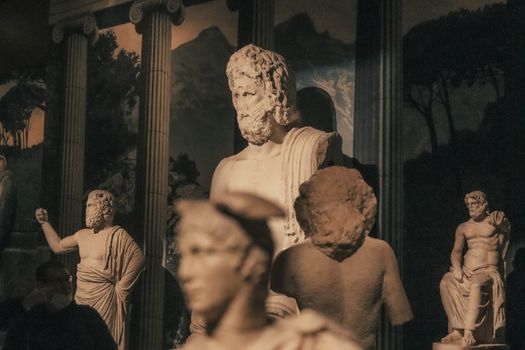 Photo: dilara irem / Pexels